Spring 2026 Complete
Inconel 718 in Jet Engine Turbine Disks
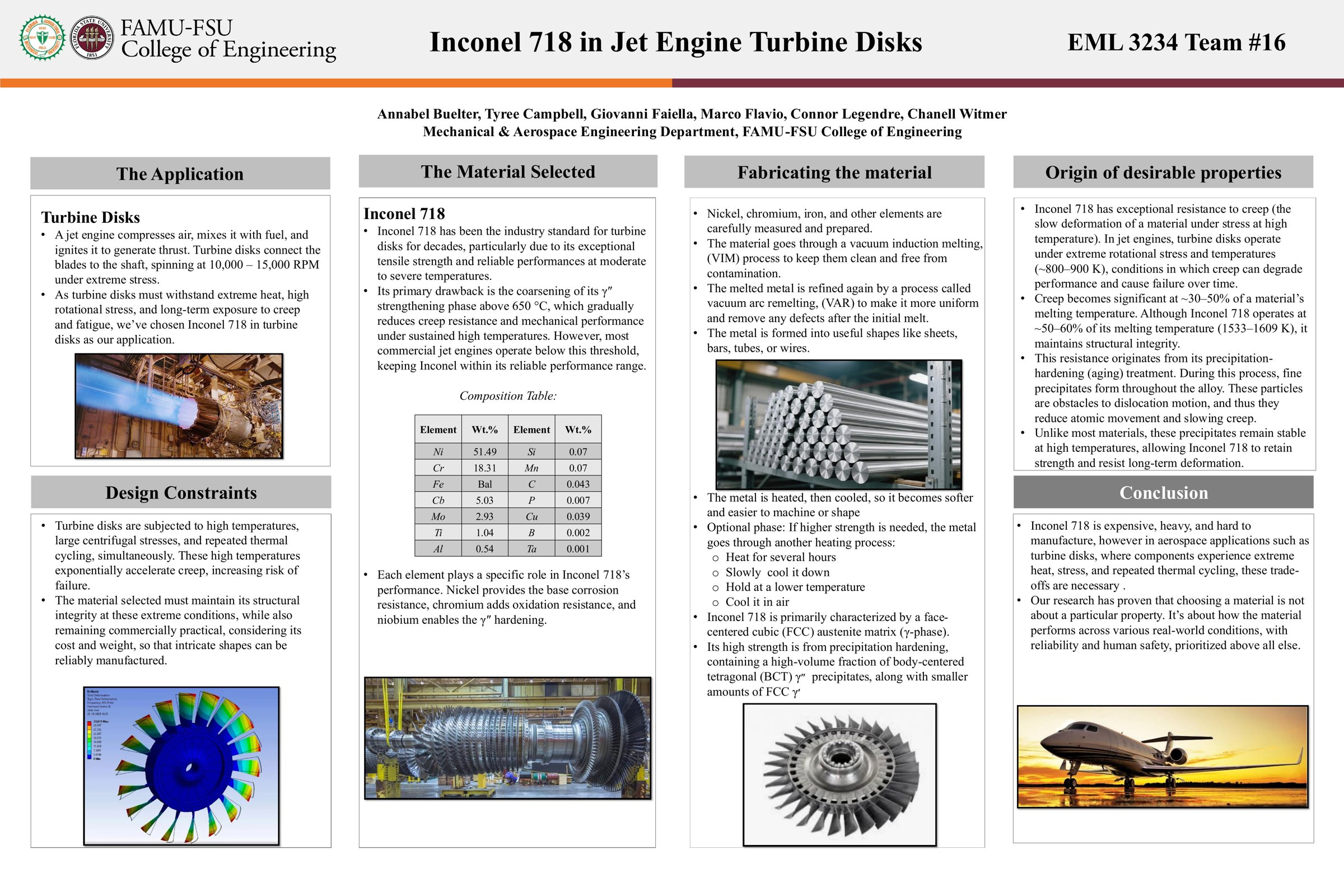
A team research poster on why Inconel 718 is the industry standard for jet engine turbine disks, from its composition and processing to its creep resistance.
Overview
For EML 3234, our team of six researched the material behind one of the most demanding parts of a jet engine: the turbine disk. Turbine disks connect the blades to the shaft and spin at 10,000–15,000 RPM while facing extreme heat, high rotational stress, and long-term creep and fatigue. We studied why Inconel 718, a nickel-based superalloy, has been the industry standard for this job for decades.
My role
- Research: I researched the application side of the project: how turbine disks work in a jet engine, and Inconel 718's track record and credibility in the aerospace industry.
- Presentation: I presented the poster to the class at a poster exhibition alongside my teammates.
Design constraints
- High temperatures, large centrifugal stresses and repeated thermal cycling, all at the same time
- High temperatures sharply accelerate creep, which raises the risk of failure
- The material also has to stay commercially practical in cost and weight, and be manufacturable into intricate shapes
What we found
- Composition: about 51% nickel and 18% chromium, with niobium, molybdenum, titanium and aluminum. Nickel provides corrosion resistance, chromium adds oxidation resistance, and niobium enables the γ″ strengthening phase.
- Processing: vacuum induction melting (VIM) keeps the alloy clean, then vacuum arc remelting (VAR) makes it more uniform and removes defects. A precipitation-hardening (aging) heat treatment then gives the alloy its strength.
- Why it resists creep: the aging treatment forms fine γ″ precipitates that block dislocation motion. They stay stable at high temperature, so the alloy keeps its strength at roughly 50–60% of its melting temperature.
- Limitation: above about 650 °C the γ″ phase coarsens and creep resistance drops, but most commercial jet engines operate below that threshold.
Conclusion
Inconel 718 is expensive, heavy and hard to manufacture. In turbine disks, where parts face extreme heat, stress and thermal cycling, those trade-offs are worth it. The main lesson: choosing a material isn't about one property. It's about how the material performs across real-world conditions, with reliability and safety first.
Team: Annabel Buelter, Tyree Campbell, Giovanni Faiella, Marco Flavio, Connor Legendre, Chanell Witmer